




Breast cancer is a leading cause of morbidity and mortality among women worldwide. In the United States, the American Cancer Society estimates that 310,730 women will be newly diagnosed with breast cancer in 2024, with an estimated 42,250 deaths from the disease 2. Studies indicate that countries with a higher Human Development Index (HDI) have higher breast cancer incidence rates, with more than 50% of cases occurring in developed and industrialized nations4 .
Risk Factors
Risk factors related to increased incidence of breast cancer include use of oral contraception; hormone replacement therapy; family history of breast, ovarian, and endometrial cancer; exposure to radiation therapy, western-type diet, obesity, excessive consumption of animal fats, high alcohol consumption, and smoking.
Clinical Features and Diagnosis
Clinical features of breast cancer often include the presence of a breast mass or an axillary mass, typically characterized by being hard and immovable. Early-stage or localized disease usually manifests as a breast mass alone, while locally advanced disease may present with additional findings such as axillary adenopathy (enlargement or changes in the consistency of lymph nodes). In metastatic breast cancer, other organs such as the bones, liver, and lungs are commonly involved.
Breast cancer diagnosis involves advanced imaging techniques, including mammograms, ultrasound, and magnetic resonance imaging (MRI). However, a definitive diagnosis can only be confirmed through a biopsy. The most common histologic types of breast cancer are infiltrating ductal carcinoma (70-80%), infiltrating lobular carcinoma (6-8%), and mixed ductal/lobular carcinoma (6-8%). Less common histologic types (<5%) include metaplastic, mucinous, tubular, medullary, and papillary carcinomas.
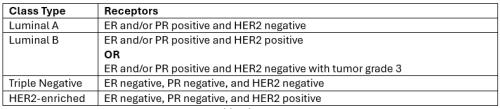
In addition to imaging and histopathological diagnoses, molecular (receptor) testing is essential for all newly diagnosed breast cancers. Molecular testing includes estrogen receptor (ER), progesterone receptor (PR), and human epidermal growth factor receptor 2 (HER2) testing, which are crucial for determining therapy and guiding prognosis. Patients who test positive for ER and/or PR are treated with endocrine therapy, while those who test positive for HER2 are treated with HER2-directed therapy. Approximately 80% of patients test positive for ER and/or PR, and 20-25% test positive for HER2. These receptors can be individually positive or negative, and based on their status, breast cancers are further classified as shown in Table 1.
Table 1: Receptor-based Breast Cancer Classification
Staging & Risk Classification
Cancer staging provided by the American Joint Committee on Cancer (AJCC) is widely accepted worldwide. The updated staging information, based on AJCC’s eighth edition, includes both anatomic stage and pathologic prognostic groups. This information is available in several reinsurance company-provided underwriting manuals or can be purchased from the AJCC Staging Online.
Treatment
The treatment of breast cancer varies depending on the staging, prognostic groups (molecular status), and extent of disease, which can range from in-situ, early-stage or local, locally advanced, regional metastasis, and distant metastasis. For simplicity, we categorize breast cancer into two groups: invasive non-metastatic and metastatic cancers.
Table 2: Breast Cancer Treatment Terminologies

Invasive, non-metastatic breast cancer
Early-stage non-metastatic breast cancer (Stages I, IIA, and a Subset of Stage IIB [T2N1])
Generally, individuals diagnosed with early-stage breast cancer undergo primary surgery, which may involve a lumpectomy or mastectomy, along with excision of regional lymph nodes. This may be followed by radiotherapy. Post-surgery, adjuvant systemic therapy is often administered based on tumor characteristics such as size, grade, the number of involved lymph nodes, and receptor status (ER, PR, and HER2).
In certain cases, particularly for those with HER2-positive or triple-negative disease, early-stage invasive breast cancer may be treated with neoadjuvant therapy before surgery.
Locally advanced (Stage IIB [T3N0] and Stages IIIA to IIIC)
Locally advanced breast cancer requires a multimodal approach. Treatment typically begins with neoadjuvant systemic therapy, followed by surgery (lumpectomy or mastectomy depending on the size of the residual tumor), regional lymph node excision, and adjuvant systemic therapy and/or radiotherapy.
Note: Triple-negative breast cancer tends to be more aggressive compared to other types and have a higher likelihood of recurrence.
Metastatic breast cancer (Stage IV)
Metastatic breast cancers are unlikely to be cured, but improvements in survival have been noted over the past decades. The most common metastatic sites in breast cancer include the bone, liver, and lungs. It is crucial to biopsy and reassess metastatic lesions for molecular status (ER, PR, and HER2), as these can change from the primary to the metastatic disease. This reassessment is essential for determining the most appropriate treatment options; considering the choice of specific anticancer medications, their combinations, and the sequence of therapy significantly impacts survival outcomes.
Prognosis
Five-year survival rates for breast cancer vary significantly based on the stage at diagnosis: 93% to 99% for early-stage disease, 75% for locally advanced disease, and 29-34% for metastatic disease 3. Survival in breast cancer depends on several factors, including age at diagnosis, the exact AJCC stage, and molecular status (ER, PR, HER2).
Early-stage non-metastatic breast cancer (Stages I, IIA, and a Subset of Stage IIB [T2N1])
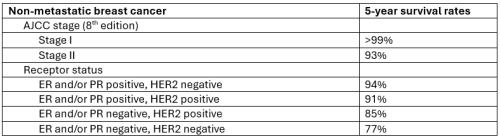
A study published on breast cancer statistics in the United States for individuals diagnosed from 2012-2018 noted stage-specific and receptor-specific five-year survival rates in early-stage non-metastatic breast cancer, as shown in Table 3.
Table 3: Stage and receptor specific 5-Year Survival Rates
A study of 1,287 individuals diagnosed with non-metastatic breast cancer observed 15-year survival rate of 67%. The rates of recurrence and metastasis based on subtype of receptor status in those with early-stage disease are shown in Table 5.
Table 4: Rate of recurrence and metastasis based on molecular status

An extensive analysis of survival in breast cancer, published in the Journal of Insurance Medicine (JIM), involving 656,601 individuals followed from 1975-2019 using the SEER dataset, noted mortality ratios of 90%, 108%, and 139% in stage 0, stage I, and stage II disease.
Overall, the prognosis of invasive early-stage non-metastatic breast cancer with appropriate treatment shows an increased risk of mortality due to the potential for recurrence and metastasis.
Locally advanced (Stage IIB [T3N0] and Stages IIIA to IIIC)
Locally advanced breast cancer presents a challenging prognosis with five-year and 20-year survival rates noted at 75% and 33.5%, respectively, according to recent studies. The prognosis remains guarded due to a high risk of early mortality within the first 10 years from diagnosis. A study published in JIM reported excess death rates ranging from 32.3 to 67.9 per 1,000 for locally advanced disease in the first 10 years from diagnosis.
Metastatic breast cancer (Stage IV)
Metastatic breast cancer continues to have a very poor prognosis despite advances in multimodal and systemic therapies. In the United States, the five-year survival rate has been noted at 29% in one study, with rates varying between 20% to 35% based on ethnicity. A comprehensive study of 47,000 women diagnosed with metastatic breast cancer revealed that only 50% of women survived beyond 3 years, and 75-80% had passed away within seven years after metastasis.
The study also highlighted that prognosis varies significantly based on the extent of metastasis: in women with only one distant metastatic site the median survival was observed at 60-66 months, while in women with more than three metastatic sites it was at 12-15 months post-metastasis.
Summary
In conclusion, breast cancer remains a significant illness that impacts mortality. Advances in early detection and treatment have significantly improved survival outcomes, especially in non-metastatic cases. However, prognosis varies greatly depending on the stage at diagnosis, molecular characteristics, and the extent of metastasis. While early-stage breast cancer patients often experience favorable long-term outcomes, those with locally advanced or metastatic disease face a more guarded prognosis.
Footnotes:
- Sung, Hyuna, et al. “Global cancer statistics 2020: GLOBOCAN estimates of incidence and mortality worldwide for 36 cancers in 185 countries.” CA: a cancer journal for clinicians 71.3 (2021): 209-249.
- Siegel, Rebecca L., Angela N. Giaquinto, and Ahmedin Jemal. “Cancer statistics, 2024.” CA: a cancer journal for clinicians 74.1 (2024): 12-49.
- Giaquinto, Angela N., et al. “Breast cancer statistics, 2022.” CA: a cancer journal for clinicians 72.6 (2022): 524-541.
- Luo, Chenyu, et al. “Global and regional trends in incidence and mortality of female breast cancer and associated factors at national level in 2000 to 2019.” Chinese medical journal 135.01 (2022): 42-51.
- Taskindoust, Mahsa, et al. “Survival outcomes among patients with metastatic breast cancer: review of 47,000 patients.” Annals of surgical oncology 28.12 (2021): 7441-7449.
- Fendereski, Afsaneh, et al. “Long-term outcomes of non-metastatic breast cancer patients by molecular subtypes.” BMC Women’s Health 22.1 (2022): 268.
- Milano, Anthony F. “Breast Cancer: 20-Year Comparative Mortality and Survival Analysis by Age, Sex, Race/Ethnicity, Stage, Grade, Disease Duration, Selected ICD-O-3 Oncophenotypes, and Cohort Entry Time-Period: A Systematic Review of 656,501 Cases for Diagnosis Years 1975-2019:(SEER* Stat 8.4. 0.1).” Journal of Insurance Medicine 50.2 (2023): 80-122.
Any views expressed in this article are those of the author(s) and may not necessarily represent those of Life Risk News or its publisher, the European Life Settlement Association