




Nassim Nicholas Taleb – author of The Black Swan – once said “The greatest risk is not the risk you can measure. It’s the one you never saw coming.”
This summarises pricing litigation risk in the life settlement market quite well because that’s generally how a lot of people have priced litigation risk; they just crossed their fingers that it wouldn’t occur, or they added some percentage into the litigation risk premium, and hoped that accounted for the risk that they’ve tried to price for.
Litigation risk takes multiple forms, from cost of insurance increases to estate challenges, from credit risk to STOLI (stranger-owned life insurance) cases. What I’d like to introduce here is a new framework to price litigation risk with a little bit more logic, data, and structure.
The Traditional Life Settlement Pricing Model
In the traditional life settlements pricing model (Figure 1) the net present value of the benefits minus the net present value of the premiums equals the price. It often assumes fixed premiums – in the sense that whatever premium stream that is put into the net present value of premiums is not going to increase – and the benefit normally assumes that it’s a sure thing as well.
Figure 1: Traditional Life Settlement Pricing Model

It can ignore direct inclusion of litigation, cost of insurance (COI) and credit risks, and although these can be included in discount rate premia, that doesn’t always work, because the discount rate affects life settlements primarily with the life expectancy. As we will see later, these risks can increase with duration, however the discount rate premium method is a square peg into a round hole as there is sometimes also a constant risk independent of duration (e.g. STOLI). Another interesting thing about life settlements compared to other asset classes is that we have a negative coupon – we’re paying the premiums.
So, when you increase the discount rate on the expected premium cash flows to account for the credit risk, including COI increases, the policy price goes up. It’s working the opposite way to what would seem intuitive – that the price falls to accommodate the added risk. So, there is scope for refinement and additional sophistication to model these forms of risk that can often end up in litigation.
A New Life Settlement Pricing Model
A better way to account for these risks is as follows:
- To multiply the expected benefit by one minus the default probability, which can be called the complement default probability.
- Then we need to introduce another factor called the expected litigation outcomes, where we assess the net present value of the actual litigation outcomes minus the costs associated with these. And bearing in mind, these have different timeframes and litigation delays, and that all needs to be factored in.
- And then on the last alteration, we adjust the expected premiums. Again, here we’re not going to assume that they’re just going to be fixed for the remainder of the term (except on guaranteed premium scenarios), and on a longer life expectancy case, on a particularly weaker carrier, that’s going to be an unrealistic assumption. So, we’re incorporating the full range of possible outcomes, that includes increases to the non-guaranteed expected premiums and multiplying these with the probabilities of increases. We also still include the scenario that they don’t increase and associate that with a probability as well, but not 100% as traditionally assumed, unless the premiums are guaranteed with a secondary shadow account or otherwise.
Figure 2: New model

This framework introduces more reliable safeguards for investors’ capital when we’re purchasing policies or valuing policies, and it beats the litigation risk premium or the credit risk premium approach that we traditionally see.
If we take the current PHL Variable rehabilitation as an example, there were warning signs more than a decade ago. PHL’s credit rating from AM BEST began to deteriorate in the 2014 to 2017 period before falling to BB in 2019 before having the rating completely withdrawn in 2020. This shows that we can’t just ignore credit risk or bake it into the discount rate, because it’s not appropriate to do that in all cases, especially on the weaker carriers.
So obviously the red flag here was the ratings erosion over time. And it can have real consequences for investors because it’s systemic across a big block of policies. We’re talking about billions of dollars here.
So how can we assign default probabilities into the formula? Well, one area to help is AM BEST’s Idealised Default Matrix. Here they’ve published how they see their cumulative default probability ranging with different durations and by their different ratings.
Figure 3: AM Best’s Idealized Default Matrix
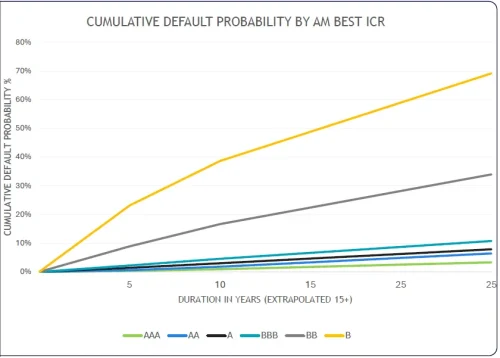
We can see from Figure 3 that by duration, it’s pretty low risk on BBB ratings and below. But we can see as the ratings become worse from here, the risk gets much higher. And on the longer-life expectancy cases where we’re looking at longer expected durations, we’re getting quite significant risks here.
So, this provides a framework for us to better predict actual cash flows and rehabilitation events going forwards. And it may mean that we need to adjust the software that we use to build in this new formula. But in my opinion, that will improve the risk management that we action in the market, and is a worthwhile development.
How, then, do we build in premium increases and their probabilities? Well historically COI increases have diverged significantly by carrier, with the mid-range being between 40% to 70%. And we can provide a framework for pricing these because there are various flags that we can spot to help assign the probabilities, such as AM BEST’s credit rating, as we saw with PHL. Obviously, we know that the risk was isolated to a certain block of PHL’s business but doesn’t mean that credit risk isn’t there for other carriers as well as for other blocks.
Some of the other red flags are known, such as the track records of certain carriers with regards to increasing their COI rates. Whilst they have freeze periods there is a risk that they increase again when those periods end.
And block-specific issues such as:
- high concentrations of older legacy, high face amount and low lapse rate policies,
- aggressive pricing of the premiums to capture market share, or
- the block being bought out by a new entity which has a new outlook on the profits.
All of these factors can help us to identify premium increase risks. Each flag raises the probability of a premium hike. Again, it’s not a perfect science, but it is superior to the credit discount rate premium and the litigation discount rate premium options, and these more considered inputs provide more structure into the framework.
So, how might we compute the litigation cash flow vectors? Now, this is, again, not a perfect science, but with consultation with litigation firms working in the space, and AI helping to gather data, gain insights, and educate on different litigation events, we can come up with a framework to put all the different litigation scenarios together, and estimate the probabilities of these occurring, with their delays and financial outcomes. Of course, professional judgement may be needed, and all research fact checked. And from there, we can calculate the present value of all the scenarios and get a better account of the financial litigation outcome risk.
All of the above impacts to the price can be calculated externally if needed and equated to a discount rate premium within the traditional pricing framework, which will then allow for this framework to be used with current actuarial software. However, when stochastically projecting future cash flows, it won’t be assessing the true randomness of the portfolio outcomes, unlike this new pricing framework approach.
Conclusion
AI technology, ratings agencies, market research, and legal insights are all very useful tools that can be used to start quantifying litigation risk, the pricing of which has been ignored for too long by the life settlement market.
As an industry, we may need to push our software providers for extra functionality to help with this. A reminder that all of these assumptions can be independently validated for credibility by consultancy firms. By incorporating these more advanced risk factors into the industry’s pricing model, investor capital and returns will be safer, and that’s what everyone wants for the long-term security and growth of our market.
Liam Bodemeaid is an Actuarial Consultant at ARM (Actuarial Risk Management)
Any views expressed in this article are those of the author(s) and may not necessarily represent those of Longevity & Mortality Investor or its publisher, the European Life Settlement Association