




Over the years, we have witnessed the successful commoditisation of several risks, including credit risk, interest rate risk and property catastrophe risk, opening up their trade to capital markets investors. Similar commoditisation of longevity risk has been slow to take off, despite many seeing a significant need for more risk takers in the market to boost capacity to service the world-wide c$80tr of longevity-linked liabilities.
During May’s ELSA Life ILS conference, Jennifer Haid, CEO of Club Vita hosted an expert discussion with Joyeeta Kanungo (Phoenix), Stephen Richards (Longevitas), Scott Willkomm (Life Equity) and Phil Kane (Leadenhall Capital) on the current outlook for a commoditised longevity risk market. Here are some key learnings from this session.
What is longevity / life risk?
Longevity risk is the risk that people live longer lives than expected. Any institution guaranteeing lifetime payments is exposed to adverse longevity risk. This includes defined benefit pension funds, life insurers, reinsurers, and government social security systems. Life insurers are also exposed to the opposite risk of policyholders dying sooner than their expected. Collectively, this pair of opposing risks is called “life risk”.
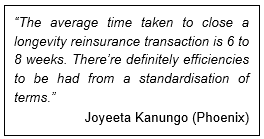
As part of an effective risk management strategy, the originator of a risk will often look to transfer it to a party better suited to handle it. This risk taker, may itself then look to pass on all or some of this risk. This process, known as the risk transfer chain, can continue and should result in risk ultimately ending up in institutions that are better equipped to manage it. But the more market frictions, the more inefficient the risk transfer chain becomes. Currently, in almost all cases, each step of the longevity risk transfer chain is underpinned by full indemnity contracts, tracking the survival of a named group of people. This means risk cedants are relieved of their complete profile of longevity risk, but risk takers take on highly specific long-term contracts that are difficult to trade.
What do we mean by the commoditisation of longevity risk and what are its benefits?
The commoditisation of longevity risk is the development of fungible, tradable financial instruments linked to longevity risk that increase the efficiency of each step of the risk transfer chain and ultimately the creation of a deep liquid market for longevity risk. Commoditisation should attract more, much needed, capacity in longevity risk takers. This is expected largely to come from capital markets investors entering the market, attracted by returns diversified against key financial risks, with some extra capacity also released from existing players due to standardisation and automation.

It is often not economical for small pension funds to enter into complicated indemnity contracts to remove longevity risk. Streamlining of contracts such as those implemented by Mercer and Zurich have opened up this market to smaller players to a certain extent, but complete commoditisation would open it up further. By simplifying the process and increasing the supply of risk takers, commoditisation should create competitive pricing for longevity risk transfers. The clearing price will of course be affected by any increase in demand, but price loadings due to market frictions should be reduced; a commoditised market could allow risks that have not traditionally attracted insurers or reinsurers, such as deferred annuity longevity risk contracts. A standardised risk classification system and index-based instruments will enable more efficient risk management solutions, in particular allowing more efficient balancing of longevity and mortality risk and reducing capital demands.
Why hasn’t it happened (yet) and what needs to happen to develop this market?
Commoditisation is based around insuring longevity trend risk and results in some components of risk being left with the risk cedant. Cedants may prefer to transfer all their risk, especially as current market prices are perceived as low. The capacity of risk takers has so far been sufficient for the risk cedants coming to market – only a small percentage of world-wide longevity-linked liabilities have transferred into global reinsurance regimes.

There is no fixed precedent for the capital relief available to insurers when using commoditised structures to pass on their longevity trend risk. Insurers want to ensure they receive the capital relief they deserve in the event of insuring risks; investors have been put off by the length of term in traditional run off longevity hedges. To dates there has been no wide acceptance of a standardised model, index or terms on which to trade commoditised longevity.
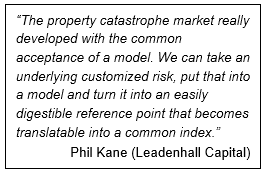
For a commoditised market to develop, there needs to be a standardisation of terms for the writing of financial instruments. Central to that will be the development of a set of widely accepted and accessible reference indices that would mimic the movements on the risk cedants’ balance sheets. Index-linked instruments would be highly tradable and could protect cedants from extreme outcomes; they would also allow risk traders to act on their sentiment to future longevity risk. Innovative approaches to structuring financial instruments need to be developed that are attractive to both risk cedants and risk takers, in particular, instruments that reduce the time horizon of traditional indemnity swaps (such as those using commutation mechanisms) are needed to attract capital market investors. Shrinking the margins of dealers in a commoditised market could help to increase returns. Articulating the potential capital benefits of pairing longevity and mortality risk, or the diversification effect of longevity with key financial risks could help engage investors with the potential returns.
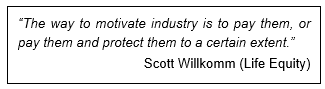
In the event of a capacity crunch in the conventional longevity market, the cost of protection could rise, offering higher returns for capital market investors. If governments could provide some back up liquidity in the market as they do in some secondary mortgage markets, it may encourage more risk takers to enter the market and ultimately strengthen the whole eco-system. Confirmation of regulatory capital relief obtained from any new financial instruments must be confirmed before they will become attractive to institutions governed by those capital requirements.
Why is now any different?
Despite some previous false starts for the commoditised longevity market, it feels like the stars may finally be aligning. Over the last few years there has been real concern in the reinsurance community about a capacity crunch if the projected annual market demand materialises. Pension fund consolidators and the success of streamlined longevity swap contracts are bringing smaller pension funds into the de-risking market and new ideas about structuring financial instruments to address the key obstacle of shorter term contracts have now been developed. Players in the market such as Longitude Exchange and Club Vita are working to standardise models and index data to get everyone talking the same language.
For a market to develop, timing of many factors need to align. Maybe that is what’s happening right now.
Erik Pickett PhD FIA CERA, is Actuary & Chief Content Officer at Club Vita
Any views expressed in this article are those of the author(s) and do not necessarily reflect the views of Life Risk News or its publisher, the European Life Settlement Association